
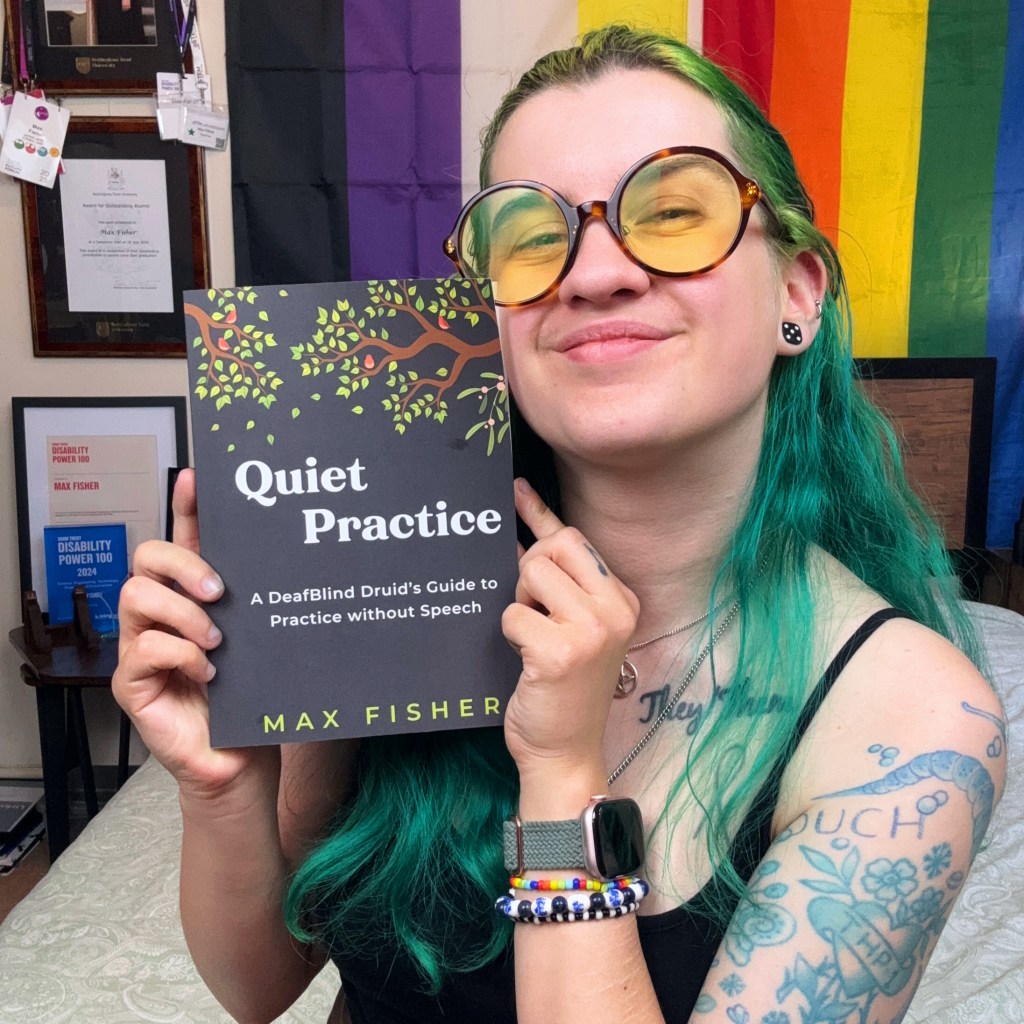
I wrote a book!
Quiet Practice, A DeafBlind Druid’s Guide To Practice Without Speech, explores the role of speech in spiritual practice from the perspective of sensory loss. Growing up as a young pagan, all the books I was reading instructed me to speak. I used to be quite shy, and nervous about other people hearing me. I didn’t want to speak in case I drew attention to myself. Then, later in life when I became DeafBlind, I realised that listening held challenges too. Druids love standing in a circle, and it is great fun. But it’s not the most accessible when I need to see a speaker’s face in order to fully understand, or to be able to “repeat after me”. Druids also love working by candlelight, which, with visual snow syndrome, is not easy to see or read in. There were no resources for me when I was trying to figure out how to fully engage in spiritual practice without having to speak. So I wrote one.
This book firstly examines the role of speech in spiritual practice, asking “why are pagans always chanting?”. We also discuss who can benefit from quiet practice (spoiler alert: everyone). It’s not solely aimed at DeafBlind people, it’s aimed at people who are non-verbal/non-speaking, people with speech disorders, people with anxiety, people with voice dysphoria, and people with open minds who want to try something new. Even now, as a public speaker, turning my voice off for spiritual practice holds tremendous value. We then look at each of the 5 senses, and explore how they can support spiritual practice in place of speech. Disability is not a monolith. Each of the senses is explored individually, and also in conjunction with each other. Multi-sensory loss does not always mean sight and hearing have been lost. There are activities that focus on each of these senses, and encourage the reader to think about how they might like to use it in their spiritual practice.
We then move on to the practical side of druidry, and discuss ideas about what we can DO. Where possible, I give ideas on how to tailor each activity to a range of support needs. For example, when using water in quiet druidry, if able, the reader is encouraged to go outside and dip their toes in a natural body of water. If the reader is not able, there are adaptations such as having a bath or a shower, with or without assistance from a carer, or placing their feet, legs, or hands in a bowl of water, or under a tap.
Druidry and paganism can be practiced on both a group and an individual basis, and Quiet Practice supports both setups. Once we have gathered our ideas, the reader is empowered to advocate for themselves and their journey, with in-depth advice from my experiences as a multi-award winning advocate. I give advice for advocacy in general, and in the context of specific group leadership structures. There is advice for solo practice, group membership, and group leadership. Most groups I have worked in have not had any experience of working spiritually with a DeafBlind person before, or even a disabled person. This book aims to change that. We ask leaders to consider how to make their groups more inclusive, and encourage group members to be open-minded to change. While written from a druid lens, I believe that people from other faiths can gain ideas from it.
Disabled people deserve to have a faith. Disabled people belong in spiritual spaces as active participants. Disabled people belong in faith.
In my experience, people panic when I introduce myself as a disabled participant in a spiritual activity. There is also a ‘stigma’ that we should be prayed for to be “fixed”. The role of disabled people in faith spaces is so much more than that. I have had experiences with pagan groups who found themselves at home in forests in the dead of night, while I was bordering on having a panic attack because I couldn’t see anything due to nightblindness and visual snow, and I couldn’t hear anyone. Feeling like you are alone in the dark in the middle of the woods can be very scary, even though you know your friends are right there… somewhere…
I want this book to help people to help each other, in whatever way they can.
Available from:
 Max Fisher RSci
Leave a comment